Selecting a suitable PUR hot melt adhesive is critical for high-quality wood panel flat lamination. In custom cabinet and decorative panel manufacturing, mismatched panel lamination adhesive commonly causes film peeling, edge lifting, bubbling, and poor weather resistance. This guide focuses purely on how to select woodworking PUR adhesive for specific material combinations, covering flat lamination for MDF, particle board, plywood, HPL, PVC film, and PET film.
Professional
PUR adhesive for panel lamination features moisture curing, high bond strength, and superior heat and moisture resistance. It has replaced traditional EVA adhesives as the preferred
flat lamination adhesive for mid-to-high-end furniture.
Proper PUR selection matched with substrates, decorative films, and production conditions directly boosts product yield, durability, and market competitiveness. Compared with conventional adhesive solutions, reactive PUR systems deliver far more stable long-term performance in complex woodworking lamination scenarios, which is why more furniture manufacturers are
switching to professional PUR hot melt adhesive for panel processing.
2. Core Benefits of Professional PUR Adhesive for Woodworking Flat Lamination
Custom woodworking PUR adhesive solves core lamination pain points including weak adhesion, delamination, and poor environmental resistance. Its key advantages for flat lamination applications are listed below:
- Superior initial tack & final bond strength: Ensures instant positioning during flat pressing, avoids material displacement, and eliminates long-term peeling and delamination risks for laminated panels
- Outstanding heat & moisture resistance: Adapts to high-humidity and high-temperature scenarios such as kitchen cabinets and bathroom decorative panels, maintaining stable bonding performance without failure
- Wide material compatibility: Perfectly matches porous wood-based panels and dense decorative films, serving as the dedicated MDF lamination adhesive, plywood lamination glue, and HPL/PVC/PET film bonding solution
- Efficient production adaptability: Features controllable open time and fast curing speed, matching automated flat lamination production lines to improve overall production efficiency
- Durable weather resistance: The moisture curing reaction forms an irreversible bonding layer, effectively resisting temperature changes and humidity erosion for long-term service stability
3. Key Selection Criteria for PUR Panel Lamination Adhesive
No universal PUR adhesive for panel lamination fits all scenarios. Optimal selection depends on five core factors: substrate type, decorative surface material, production speed, coating equipment, and end-use environment, enabling fast and accurate adhesive matching for manufacturers.
Selection Factor |
Specific Influence on PUR Adhesive Selection |
|---|
Wood Substrate Material | Determines adhesive penetration, wettability, and filling performance. Porous boards require strong penetration, while uniform boards demand stable wetting |
Surface Decorative Material | Dense films (PET/HPL) require high-adhesion PUR formulas; flexible PVC films need low-stress, flexible bonding PUR adhesive |
Production Speed | High-speed automated lines need short open-time PUR; manual/slow lines adopt long open-time flat lamination adhesive to avoid insufficient pressing time |
Coating Equipment | Match adhesive viscosity with roller coating/spray coating equipment to ensure uniform coating and no glue accumulation or missing coating |
Final Application Environment | Kitchen/bathroom panels prioritize heat and moisture resistance; indoor decorative panels focus on surface flatness and cost performance |
4. PUR Adhesive Selection Guide by Wood Substrate (MDF / Particle Board / Plywood)
Wood-based panels differ greatly in surface density, porosity and structure, serving as the core basis for woodworking PUR adhesive selection. Targeted formula matching effectively avoids substrate-mismatch bonding defects.
4.1 Best PUR Adhesive for MDF Lamination
MDF is the mainstream substrate for high-gloss panels, cabinet doors and wall panels, widely paired with PVC, PET and HPL via MDF lamination adhesive. It features a smooth, uniform surface but strong glue absorption, with surface dust easily impairing bonding quality.
MDF Lamination PUR Adhesive Core Requirements:
- Excellent surface wettability: Fully fits the smooth MDF surface to eliminate bubble gaps
- Moderate penetration: Avoids excessive glue absorption leading to insufficient surface adhesive residue and weak bonding
- Stable open time: Matches high-speed MDF flat lamination line rhythm
- High final bonding strength: Ensures long-term stability of high-gloss decorative panels
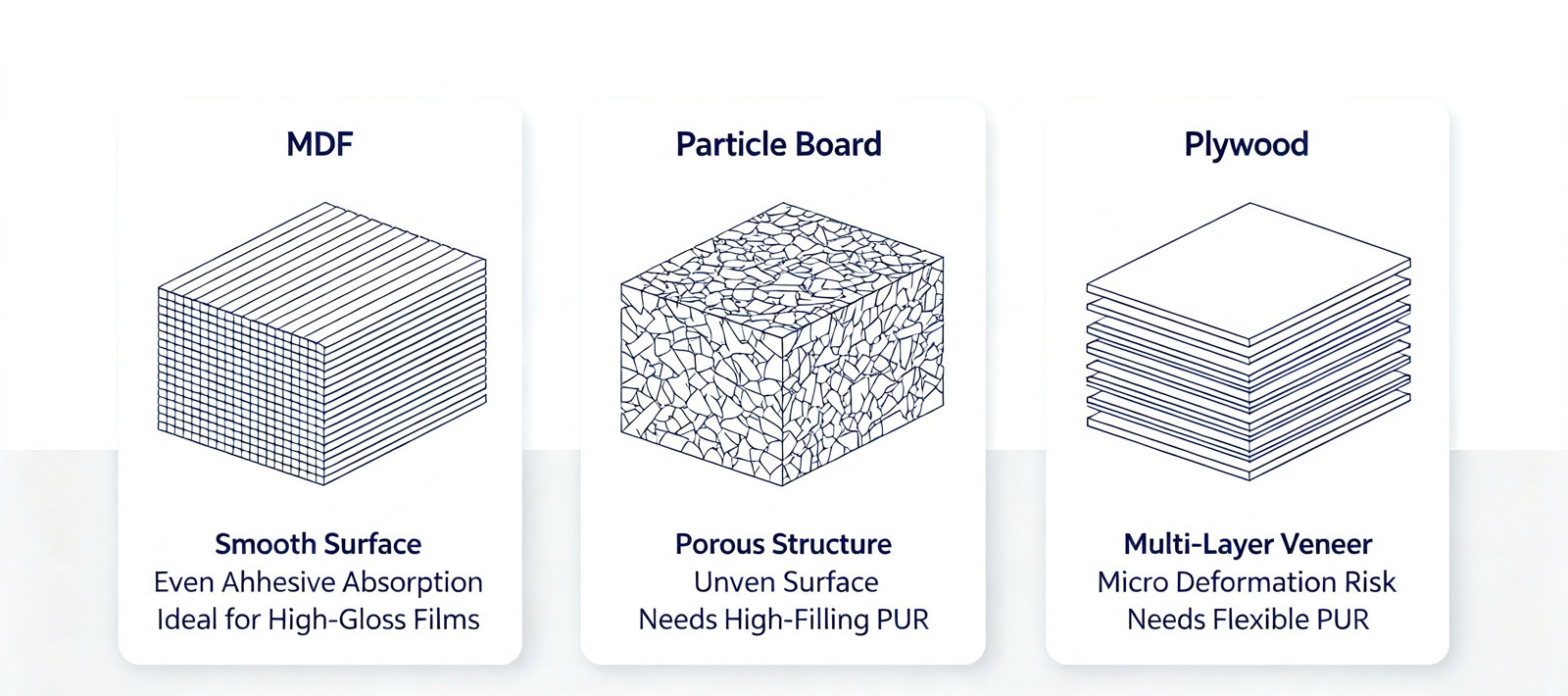
Applicable Matching Combinations:MDF + PVC film, MDF + PET film, MDF + HPL flat lamination. For high-gloss PET decorative panels with ultra-smooth surfaces, customized PUR formulas are essential to avoid delamination, consistent with the high-standard bonding requirements summarized in our PUR adhesive solutions for high-end furniture surface bonding.
4.2 Best PUR Adhesive for Particle Board Lamination
Particle board is commonly used for cabinets and office furniture. Its uneven, porous surface requires adaptive flat lamination adhesive with excellent filling and bonding performance to compensate for surface irregularities.
Particle Board Lamination PUR Adhesive Core Requirements:
- Strong initial adhesion: Quickly positions decorative materials to prevent offset during pressing
- Superior filling performance: Makes up for particle board surface unevenness to form a complete bonding layer
- Flexible bonding performance: Relieves internal stress of the board to avoid cracking and delamination caused by structural deformation
Applicable Matching Combinations: Particle board + HPL, particle board + PVC film flat lamination. Particle board’s porous and uneven surface puts forward higher requirements for adhesive filling performance, and professional woodworking PUR adhesives can perfectly adapt to such complex substrate characteristics, effectively reducing the defective rate of panel lamination production.
4.3 Best PUR Adhesive for Plywood Lamination
Plywood is a premium multi-layer substrate for high-end furniture and decorative panels. Prone to minor deformation from temperature and humidity changes, it requires flexible and stable plywood lamination glue for long-term reliable bonding.
Plywood Lamination PUR Adhesive Core Requirements:
- High flexibility: Follows plywood micro-deformation without peeling or edge lifting
- Excellent moisture resistance: Prevents plywood moisture expansion from damaging the bonding interface
- Long-term aging resistance: Ensures stable bonding of high-end plywood decorative panels for years
Applicable Matching Combinations:Plywood + HPL, plywood + decorative film flat lamination. Plywood is widely used in high-end decorative engineering and customized furniture, and its bonding durability directly affects product service life. The flexible and weather-resistant advantages of plywood-specific plywood lamination glue are also applicable to other multi-layer composite substrate lamination scenarios.
5. PUR Adhesive Selection Guide by Surface Decorative Material
Decorative films (PVC, PET, HPL) vary in surface density and tension, directly affecting PUR adhesive for panel lamination compatibility. Dense, low-surface-energy materials require customized high-performance PUR formulas for stable lamination.
5.1 PUR Adhesive for PVC Film Flat Lamination
PVC film is a flexible, widely used decorative material for cabinet and furniture panels. The key to PVC lamination is selecting adhesive that adapts to the film’s thermal expansion and contraction.
Key PUR Adhesive Performance: Excellent PVC compatibility, low-temperature flexibility, and strong initial tack to prevent cracking and delamination. It is the most cost-effective flat lamination adhesive for standard PVC furniture lamination. This flexible bonding feature is similar to the adhesive performance requirements of soft material lamination in other industries, achieving stable fitting and deformation resistance.
5.2 PUR Adhesive for PET Film Flat Lamination
High-gloss PET film is popular for premium custom furniture and modern kitchen cabinets. Its ultra-smooth, dense surface delivers low surface tension, making it the most challenging common material for lamination and prone to delamination with ordinary adhesives.
Key High-Performance PUR Adhesive Performance: Custom formula for low-surface-energy materials, featuring high bond strength, heat resistance and aging resistance. It solves PET film high-temperature peeling issues, serving as the dedicated solution for high-end PET panel lamination.
5.3 PUR Adhesive for HPL Flat Lamination
HPL is a hard, wear-resistant laminate used for commercial furniture, kitchen cabinets and high-wear decorative panels, requiring PUR adhesive with superior environmental resistance and durable bonding strength.
Key PUR Adhesive Performance: High final bond strength, outstanding heat/moisture resistance and shear resistance, preventing long-term peeling and failure in harsh usage environments.
6. PUR vs EVA Hot Melt Adhesive: Which Is Better for Panel Lamination?
Furniture manufacturers typically choose between PUR and EVA hot melt adhesives for flat lamination. The following comparison enables fast, cost-effective adhesive selection based on product positioning and application requirements.
Performance Dimension | PUR Hot Melt Adhesive | EVA Hot Melt Adhesive |
|---|
Bonding Strength | High, no long-term delamination | Medium, prone to peeling after long-term use |
Heat & Moisture Resistance | Excellent, suitable for harsh environments | Limited, easy failure in high temperature/humidity |
PET/HPL Lamination Adaptability | Perfect match, dedicated formula | Poor compatibility, high defect rate |
Applicable Scenarios | High-end furniture, kitchen cabinets, export panels, PET/HPL lamination | Ordinary indoor furniture, low-cost PVC lamination |
Cost | Higher, high cost performance for long term | Lower, only suitable for low-end products |
7. Core Process Control for Qualified PUR Panel Flat Lamination
Accurate woodworking PUR adhesive selection must be paired with standardized processes to avoid lamination defects. Four core process control points ensure qualified, stable lamination results:
7.1 Strict Surface Pre-treatment
Clean all dust, oil and debris from substrates and decorative films, and control board moisture content within standard ranges. Clean, dry surfaces maximize adhesive wettability and eliminate bubbles and weak bonding.
7.2 Precise Adhesive Coating Amount
Insufficient adhesive causes weak bonding and peeling; excessive glue leads to overflow, uneven surfaces and higher costs. Adjust coating thickness according to substrate porosity for a uniform, moderate adhesive layer.
7.3 Standardized Pressing Parameters
Optimize pressing pressure, temperature and duration based on PUR model and material type. Proper pressing ensures full lamination of adhesive, substrate and decorative film for a tight bonding structure.
7.4 Sufficient Curing Time
PUR adhesive gains initial strength after cooling and achieves full irreversible moisture curing by absorbing ambient humidity. Reserve sufficient curing time according to temperature and humidity to secure final bonding stability.
8. Common Lamination Defects: Causes & PUR Adhesive Solutions
Most flat lamination defects result from mismatchedPUR adhesive for panel lamination or non-standard processes. Common issues and targeted solutions are summarized below:
Common Defect | Root Cause | Optimization Solution |
|---|
Film Peeling | Mismatched PUR adhesive compatibility | Replace with dedicated PUR adhesive for corresponding film/substrate |
Edge Lifting | Insufficient adhesive flexibility | Select flexible formula flat lamination adhesive |
Surface Bubbles | Unclean surface / uneven pressure | Optimize surface cleaning and pressing process parameters |
High-Temperature Delamination | Insufficient PUR heat resistance | Upgrade to high heat-resistant grade PUR adhesive |
Unstable Bonding Quality | Unreasonable process parameters | Match open time and curing conditions with PUR model |
9. How to Choose a Reliable PUR Adhesive Supplier
Universal adhesives cannot meet customized production demands. A reliable
PUR hot melt adhesive supplier for panel lamination must satisfy three core criteria. Professional suppliers can provide targeted solutions for different industries and scenarios. In addition to woodworking lamination, our customized PUR adhesive solutions also cover
automotive interior lamination, textile composite bonding and other industrial fields.
- Professional industry experience: In-depth understanding of lamination characteristics of MDF, particle board, plywood, PVC/PET/HPL materials, and familiar with furniture production line processes
- One-stop technical support: Provide material testing, targeted adhesive recommendation, production process debugging, and on-site technical guidance
- Customized solution capability: Adjust adhesive formula viscosity, open time, and performance parameters according to customers’ equipment speed, material matching, and product application scenarios
10. FAQ About PUR Adhesive for Wood Panel Flat Lamination
Q1: What materials can woodworking PUR adhesive bond for lamination?
Professional PUR adhesive for panel lamination works with all mainstream lamination materials, including MDF, particle board, plywood substrates, and PVC, PET, HPL decorative films, covering most furniture and decorative panel lamination scenarios.
Q2: What is the best PUR adhesive for MDF lamination?
High-performanceMDF lamination adhesive features excellent wettability, stable coating, moderate penetration and high final strength, matching MDF’s smooth surface and high glue absorption characteristics.
Q3: Why does PET film lamination require special high-performance PUR adhesive?
PET film’s dense, low-surface-energy structure resists conventional bonding. Only customized high-performance PUR adhesive delivers strong adhesion, heat resistance and long-term anti-delamination for stable PET lamination.
Q4: Is PUR adhesive better than EVA for furniture lamination?
EVA adhesive suits basic low-cost indoor furniture. For mid-to-high-end furniture, kitchen cabinets, PET/HPL panels and export products, PUR hot melt adhesive offers far superior bonding stability and environmental resistance with better long-term cost performance.
Q5: How to avoid panel lamination delamination?
To avoid panel delamination: 1. Select matched woodworking PUR adhesive; 2. Thoroughly clean bonding surfaces; 3. Control uniform glue coating; 4. Optimize pressing parameters; 5. Allow adequate curing time for full strength development.
11. About Sino-Adhesive
Sino-Adhesive provide high-performance PUR adhesive solutions, professional technical support, and customized product development services in the research, development, manufacturing, and application support of Polyurethane Reactive Adhesives (PUR Adhesives).
Our products are widely used in automotive interiors, textile lamination, woodworking, automotive electronics, intelligent display systems, packaging production, and industrial manufacturing.
If you have any questions regarding the industries mentioned above, please feel free to contact Sino-Adhesive at any time. We would be happy to assist you.

 中文
中文 English
 한국어
한국어 にほんごばん
 Français
 Deutsch
 Español
 Русский язык
 بالعربية
 português
 Italiano
 Tiếng
Việt
Tiếng
Việt คนไทย
คนไทย